
Uncategorized
why do all cryptocurrencies rise and fall together
Why do all cryptocurrencies rise and fall together
Banks haven’t signed up for the Fed’s new instant payments system as enthusiastically as some in the industry expected since its mid-2023 launch, with about 1,200 bank participants so far https://ippwatch.info/mobile/iphone-casino/. But some of the largest financial institutions are staying away.
One of the driving forces behind this trend is the development of more user-friendly and secure cryptocurrency wallets and exchanges. Platforms like Coinbase and Binance have made it easier for individuals to buy, sell, and hold cryptocurrencies. Additionally, the integration of blockchain technology into various financial systems enhances transparency and reduces fraud, further boosting confidence in digital currencies.
Central Bank Digital Currencies are legal tender issued by the central bank of a country and thus have all the properties of traditional money. China and India are amongst the countries already piloting CBDCs with the Euro area planning to introduce an E-Euro in 2027.
Are all cryptocurrencies mined
As a response, some cryptocurrencies are moving to more energy-efficient consensus algorithms like Proof of Stake (PoS) or hybrid systems. These algorithms do not rely on computational power, and as a result, they are significantly less energy-intensive.
The cryptocurrency market was virtually unstoppable last year, gaining more than 3,300% in market cap — nearly $600 billion — from where it began. The allure of the blockchain technology that underpins most virtual currencies, along with the perceived anonymity of transactions, continues to drive new investment.
The new hash outputs are then organized into pairs and hashed again, and the process is repeated until a single hash is created. This last hash is known as the root hash (or Merkle root) and is basically the hash that represents all the previous hashes used to generate it.
As noted, both methods have their own advantages and disadvantages. But if there is an X-factor here that hasn’t been discussed, it’s that eventually some of the most prominent mined cryptocurrencies, such as bitcoin, will reach their token supply limit. At such a point, it would only make sense for mined cryptocurrencies to switch over to the non-mined, proof-of-stake method. Since proof-of-stake significantly reduces electricity costs and consumption, as well as takes away the computing network threat associated with proof-of-work, my belief is we’ll see a slow but steady shift toward non-mined cryptocurrencies in the future.
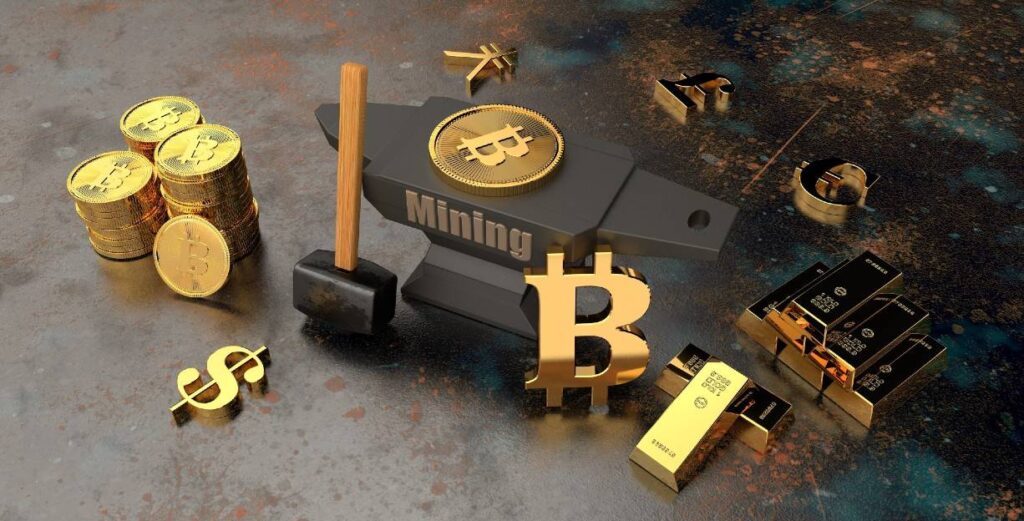
Cryptocurrency mining describes a process where an individual, group of individuals, or a business, will use high-powered computers to solve complex mathematical equations in an effort to validate a block of transactions. These mathematical equations are part of the encryption that protects transactions from cybercriminals, as well as other people who shouldn’t have access to sender and receiver data.
Imagine a global digital ledger where every cryptocurrency transaction is recorded. Mining ensures this ledger stays accurate and secure. Miners use specialized computers to solve puzzles (essentially guessing numbers) to organize and confirm pending transactions. The first one to solve it gets rewarded with cryptocurrency.
What is the market cap of all cryptocurrencies
A cryptocurrency wouldn’t be very useful if anyone could just change the history of transactions to their own liking – the point of cryptocurrency is that you can be sure that your coins belong to you only and that your balances will not change arbitrarily. This is why reaching consensus is of utmost importance. In Bitcoin, miners use their computer hardware to solve resource-intensive mathematical problems. The miner that reaches the correct solution first gets to add the next block to the Bitcoin blockchain, and receives a BTC reward in return.
The very first cryptocurrency was Bitcoin. Since it is open source, it is possible for other people to use the majority of the code, make a few changes and then launch their own separate currency. Many people have done exactly this. Some of these coins are very similar to Bitcoin, with just one or two amended features (such as Litecoin), while others are very different, with varying models of security, issuance and governance. However, they all share the same moniker — every coin issued after Bitcoin is considered to be an altcoin.
Cryptocurrency works through networks of nodes that are constantly communicating with each other to stay updated about the current state of the ledger. With permissionless cryptocurrencies, a node can be operated by anyone, provided they have the necessary technical knowledge, computer hardware and bandwidth.
Tokens, on the other hand, are crypto assets that have been issued on top of other blockchain networks. The most popular platform for issuing tokens is Ethereum, and examples of Ethereum-based tokens are MKR, UNI and YFI. Even though you can freely transact with these tokens, you cannot use them to pay Ethereum transaction fees.
ICO stands for Initial Coin Offering and refers to a method of raising capital for cryptocurrency and blockchain-related projects. Typically, a project will create a token and present their idea in a whitepaper. The project will then offer the tokens for sale to raise the capital necessary for funding development. Even though there have been many successful ICOs to date, investors need to be very careful if they are interested in purchasing tokens in an ICO. ICOs are largely unregulated, and very risky.